
Innodisk Edge Server SSD Solutions
Innodisk, Eindhoven, 14.09.2022 - One of the most anticipated trends in IT and infrastructure is the demand for Edge Computing, driven by technologies such as 5G, IoT, and AI. The need for processing, storing, and integrating data close to where it is generated continues to grow. Edge Computing with 5G creates tremendous possibilities across all industries. It brings computations and data storage closer to the data source, resulting in better data control at lower costs. Additionally, it enables faster insights and actions, as well as continuous operation. By 2025, 50% of corporate data will be processed at the edge, compared to just 10% today (Source: IBM). According to verifiedmarketresearch.com, the global market for Edge Data Centers is projected to grow from $6.26 billion in 2020 to $36.32 billion in 2028.
Edge Data Centers are smaller facilities located near data generation zones that process data directly. These data centers are managed remotely. They contain the same components as traditional data centers but are considerably smaller. They host mission-critical data, applications, and services for edge-based processing and storage. These data centers provide cloud computing resources and cached content for end-users. They are typically connected to a larger central data center or multiple data centers. An edge data center is one of many within a complex network, which also includes a central corporate data center. Processing data and services as close as possible to the end-user allows companies to reduce latency with Edge Computing. In an edge computing architecture, time-critical data can be processed at the origin by an intermediary server located geographically close to the user.
Generally, four different categories of edge infrastructure models are distinguished. The Device Edge is built into or docked to the device. Typical outdoor applications include street lighting, while indoor applications include manufacturing facilities. The Micro Edge consists of up to four racks or servers and is located on the company premises, such as retail stores, factories, IT cabinets, or municipalities. A distributed Edge Data Center is also a small data center with 5 to 20 racks, located on-site at a company location such as a warehouse, telecom network site, or public parking lot. A regional Edge Data Center is a medium-sized facility with 20 or more racks, defined by a regional location.
Applications in Edge infrastructure include the Edge Device—usually a sensor where data originates. The Edge Server or Edge DC (NAS) acts as the node and forwards data to the Gateway— the Network Edge— typically via telecommunications channels. This structure reduces latency, offers faster response times, and enables quicker and more comprehensive data analysis. Transitioning to an edge architecture presents various challenges and requirements. Limited bandwidth must be considered, and latency issues may arise. Devices must be reliable and secure. They often need to be adapted accordingly.
Innodisk supplies industrial SSDs specifically designed for use in Edge Servers. These operate reliably and without performance loss throughout their lifespan. They are available in a variety of form factors. They generally feature thermal management and are characterized by high IOPS (Input/Output Operations Per Second) and a high DWPD (Drive Writes Per Day) rating ranging from 0.8 to 2.7. Customer-specific modifications are always possible.
The interfaces SATA III and PCIe (NVMe) from Innodisk offer high performance, low latency, and multiple I/O queues. The bandwidth of SATA III is 6Gb/s, and the maximum for NVMe modules is 64Gb/s. Their latency is approximately 3µs.
Reliability is ensured through end-to-end data protection and protection against power failures. The uncorrectable bit error rate is only 10-16. With LDPC integration, RAID guarantees comprehensive data integrity and offers a broad range of RAID overhead protection. Security is secured via hardware-based AES 256-bit encryption and TCG OPAL 2.0.
Several erasure methods have been developed for data security. The ATA Security Erase command instantly deletes all user data blocks. A manufacturer command suffices for a quick erase in seconds. The Security Erase meets military standards, deleting all data blocks. The Revert Command resets the SSD to factory settings and makes user data unreadable by changing the AES key randomly. The ATA "Cryptographic Erase" command is used to wipe the SSD from all user data and render it unreadable by changing the AES key.
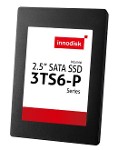
The SATA 3TS6-P series is available in form factors from 200GB to 3.2TB, while the SATA 3TS9-P series ranges from 400GB to 6.4TB. The NVMe Gen 4x4 4TS2-P series is available with storage capacities from 400GB to 6.4TB.
Publisher of the message (text / image): Innodisk Europe B.V., www.innodisk.com