
Increased lifespan for flash memory with DIE-RAID
Innodisk, Eindhoven, 09.02.2022 - As NAND flash cells are continually physically miniaturized, more cells can be housed per unit area, increasing storage capacity. However, this can lead to increased interference with the stored charge within the cell. The result is a higher error bit rate. As cells store more bits, the buffer between voltage levels diminishes, raising the likelihood of read errors. Without countermeasures, this can lead to failures in modern NAND flash memory after a relatively short period. Error correction is therefore one of the most important functions in memory products.
Due to its effectiveness, the BCH code (Bose-Chaudhuri-Hocquenghem code) is a frequently used error correction method in NAND flash. With recent technological advancements, this method has been replaced by Low-Density Parity Check (LDPC) as the standard ECC (Error Correcting Code) function for most SSDs. It has a stronger error correction capability than the BCH code and allows for a more precise identification of the original bit sequence after an error.
“DIE-RAID” is another important tool for correcting faulty bits. Its disadvantage is that SSDs seemingly have capacities below the “Power-of-Two” standard. This seemingly missing capacity is actually the storage of parity data, which is used to correct error bits when ECC cannot. In combination with other error correction functions, DIE-RAID increases the number of write/delete cycles (P/E cycles) and ensures consistent flash performance over a longer period.
Redundant Array of Independent Drives (RAID) uses mirroring, striping, and parity data storage to ensure data integrity when using two or more storage drives. By mirroring data copies from one drive onto another, it guarantees that a second data set is available in case of drive failure (RAID 1). Striping describes writing data sets across different drives instead of storing them on a single drive. Parity data is used in configurations with three or more drives, each storing a portion of the distributed parity data, to recover from the failure of one drive (RAID 5).
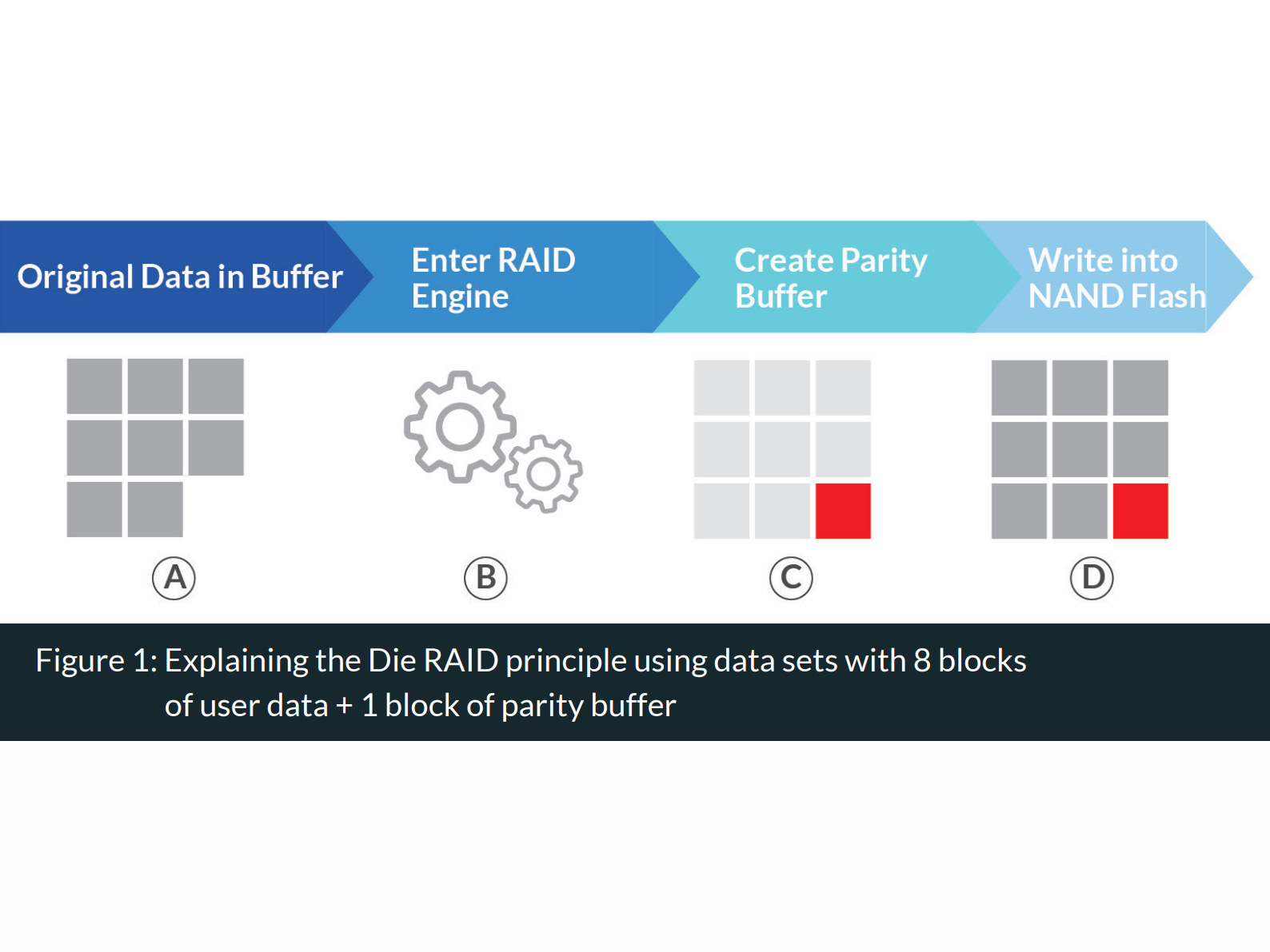
The RAID error correction method follows the same principle as standard RAID for storage drives in RAID 5. Instead of distributing data across drives, DIE-RAID distributes data across different blocks and adds a parity buffer to each set. The RAID engine, located in the controller, decides how the data received from the SSD is stored. It constructs RAID stripes and performs RAID recovery when error bits are detected and other ECC functions could not resolve the issue. When a data read command is issued, it first passes through the LDPC engine. Whether the data is correct or one or more error bits have been corrected by the LDPC engine, the data is read without issue. If the LDPC engine cannot correct the error bit, the RAID engine performs a RAID rebuild to fix the error. If it cannot correct the error, the block is marked as faulty. This means that DIE-RAID acts as an additional layer of error protection and ultimately significantly extends each SSD’s lifespan.
DIE-RAID uses a reserved portion of the SSD capacity for secure error correction. Especially in industrial applications, this function significantly contributes to increasing lifespan and ensuring improved data integrity. Therefore, DIE-RAID, because of its additional decision layer for determining bit values, delays the need for repeated read operations. This results in enhanced data integrity and a more stable, longer lifespan of the device. Suitable for all applications demanding high data throughput, ensuring long-term continuous performance of the SSD.
-
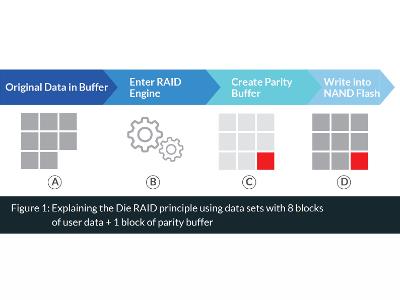
Innodisk DIE RAID Principle Diagram
Publisher of the message (text / image): Innodisk Europe B.V., www.innodisk.com
Matching products
-
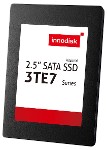
 Storage (SSD, RAM)2.5" SATA SSD 2.5 SATA SSD 3TE72.5"
3D TLC
SATA 3
3TE7
0°C to 70°C | -40°C to 85°C+9
-
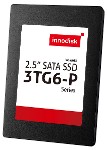
Storage (SSD, RAM)2.5" SATA SSD 2.5 SATA SSD 3TG6-P2.5"
Kioxia 3D TLC
SATA 3
3TG6-P
0°C to 70°C | -40°C to 85°C+9
-
Storage (SSD, RAM)M.2 M.2 (P80) 3TG6-PM.2
Kioxia 3D TLC
PCI Express Gen. 3
3TG6-P
0°C to 70°C | -40°C to 85°C+9
-
Storage (SSD, RAM)M.2 M.2 (P80) 4TG2-PM.2
3D TLC
PCI Express Gen. 4
4TG2-P
0°C to 70°C | -40°C to 85°C+9